




Organic Intermediates
Why Choose Us
Most Competitive Pricing
With more than 10 years working experience, we always offer the most competitive pricing to customers to help lower their cost in application.
24H Online Service
Our experienced staff is dedicated to answer all of your inquires, feedback or other requirements in 24 hours. We welcome you to contact us for more information and look forward to working with you.
High Quality
Our products are sourced directly from manufacturers and each is carefully qualified to ensure compliance with EHS&S, packaging, and quality standards. Our product stewardship efforts provide important health, safety, and environmental information to our supply chain partners.
Rich Experience
We understand what factors influence supply and demand, product availability, and pricing and we share this knowledge with our supply chain partners regularly. We provide information about products and market analysis to assist you in making better, quicker business decisions.
Company Profile
Chemintel Is a chemical company that specializes in the operation of high-quality chemicals, brand promotion and supporting services of customer supply chain. it is committed to select the most competitive chemicals produced by high-quality and sustainable manufacturers from china to provide services to global customers. so far, chemintel has launched more than 100 chemicals, of which more than 20 have the exclusive right to operate in the international market and the chinese market. our products have application in the fields of pharmaceuticals & fine chemicals, pesticides, dyes, flavors and fragrances, feed additives, green fibers & others.
So Far, Chemintchemical company that specializes in the operation of high-quality chemicals, brand promotion and supporting services of customer supply chain. it is committed to select the most competitive chemicals produced by high-quality and sustainable manufacturers from china to provide services to global customers. so far, chemintel has launched more than 100 chemicals, of which more than 20 have the exclusive right to operate in the international market and the chinese market. our products have application in the fields of pharmaceuticals & fine chemicals, pesticides, dyes, flavors and fragrances, feed additives, green fibers & others.


Organic Intermediates Include
Triphenylphosphine
Benzoate
Tris
What is Triphenylphosphine
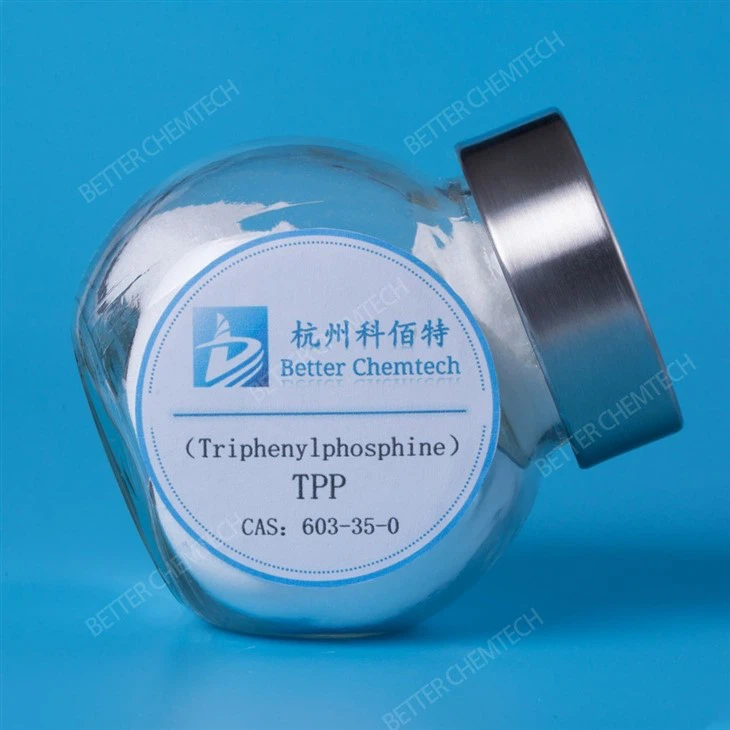
Triphenylphosphine (IUPAC name: triphenylphosphane) is a common organophosphorus compound with the formula P(C6H5)3 and often abbreviated to PPh3 or Ph3P. It is versatile compound that is widely used as a reagent in organic synthesis and as a ligand for transition metal complexes, including ones that serve as catalysts in organometallic chemistry. PPh3 exists as relatively air stable, colorless crystals at room temperature. It dissolves in non-polar organic solvents such as benzene and diethyl ether.
Triphenylphosphine can be prepared in the laboratory by treatment of phosphorus trichloride with phenylmagnesium bromide or phenyllithium. The industrial synthesis involves the reaction between phosphorus trichloride, chlorobenzene, and sodium:[5]
PCl3 + 3 PhCl + 6 Na → PPh3 + 6 NaCl
Triphenylphosphine crystallizes in triclinic[6] and monoclinic modification.[7] In both cases, the molecule adopts a pyramidal structure with propeller-like arrangement of the three phenyl groups.
Reactions of Triphenylphosphine
Quaternization
Alkyl halides and $PP{{h}_{3}}$PPh3 react at elevated temperatures with the help of metal catalysts to form phosphonium salts. Benzylic and allylic halides undergo an extremely rapid quaternization process.
Mitsunobu Reaction
A mixture of triphenylphosphine and diisopropyl azodicarboxylate ("DIAD" or its diethyl counterpart, DEAD) transforms alcohol and a carboxylic acid into an ester in the Mitsunobu reaction. The $PP{{h}_{3}}$ is oxidised to $OPP{{h}_{3}}$PPh3 is oxidised to OPPh3
and the DIAD is reduced while acting as the hydrogen acceptor.
Oxidation
Slow air oxidation of triphenylphosphine results in triphenylphosphine oxide.$2PP{{h}_{3}}\,+\,{{O}_{2}}\,\to\,2OPP{{h}_{3}}$2PPh3+O2→2OPPh3
Chlorination
Triphenylphosphine dichloride, which occurs as the moisture-sensitive phosphonium halide, is produced when Chlorine reacts with PPh32Ph3PCl2+NH2OH.HCl+Ph3P→{[Ph3P]2N}Cl+3HCl+Ph3PO
Protonation
Being a weak base PPh3P(C6H5)3+HBr→[HP(C6H5)3]+Br−
Uses of Triphenylphosphine
Triphenylphosphine can form complexes with transition metals and be used as a catalyst. These catalysts are effective in
Many organic synthesis reactions play critical roles, such as hydrogenation of olefins, reduction of hydrides, and carbon
-The formation and cleavage reactions of carbon bonds.
Triphenylphosphine can form various complexes with metal coordination ions, which can Materials science has important application value. For example, they can serve as intermediates for liquid crystal molecules, used for Preparation of flexible displays and solar cells, etc; It can also form conductive polymer materials for preparing conductive plastics Materials and organic electronic devices, etc.
Triphenylphosphine can be used as a reducing agent and a reagent for naphthalene formation reactions, and is widely used in organic synthesis Medium. For example, it can reduce alkynes to olefins in the presence of hydrogen gas; It can also react with acyl chloride to produce Generate corresponding esterification products.
Triphenylphosphine can be used to separate and determine metal ions, such as by forming complexes Improve analytical sensitivity.
Sodium benzoate is a preservative found in fruit juices, fermented foods, sauces and some pancake syrups.This food chemical has been linked to a variety of health harms, including damage to DNA, hormone disruption and reduced fertility. Sodium benzoate also poses a cancer risk, but only when combined with ascorbic acid, citric acid or vitamin C. When it’s combined with any of these compounds, it forms benzene, a chemical associated with blood cancers.The same chemical process happens when ascorbic acid, citric acid or vitamin C is combined with another preservative potassium benzoate.

The Efficacy and Role of Sodium Benzoate
Food Preservation
Sodium benzoate is often used as a preservative in the food industry to extend the shelf life of food, inhibit the growth of bacteria and mold, and maintain the freshness of food.
Antifungal Effect
Sodium benzoate has certain antibacterial effects on certain fungi, so it is often used in pharmaceuticals, cosmetics and personal care products to prevent the growth of mold or other fungi.
Skin Care
In some cosmetics and personal care products, sodium benzoate may be added as a preservative to maintain the freshness of the product, while some products may also be used in skin care for its antifungal effects.
Medical Applications
In some pharmaceutical preparations, sodium benzoate may be used as a preservative to ensure that the drug remains sterile during the period of use.
Preservation of Dairy Products
In some dairy products, such as cheese, yogurt, etc., sodium benzoate is also used as a preservative to extend their shelf life.
Benzoic acid preservatives act on their undissociated molecules. Undissociated benzoic acid is highly lipophilic and can easily pass through the cell membrane and enter the cell, interfering with the permeability of the cell membrane of microorganisms such as molds and bacteria, and hindering the absorption of amino acids by the cell membrane. It absorbs benzoic acid molecules that enter the cells, acidifies the alkali storage in the cells, inhibits the activity of respiratory enzymes in the microbial cells, and thus plays an antiseptic role.
Benzoic acid is a broad-spectrum antimicrobial agent that is very effective against yeasts, molds, and some bacteria. Within the maximum allowable range of use and with a pH value below 4.5, it has an inhibitory effect on various bacteria.
What are the Applications of Sodium Benzoate
In The Field of Medicine:As a drug intermediate, sodium benzoate is used in the synthesis of a variety of drugs, such as non-steroidal anti-inflammatory drugs, antibiotics and anti-cancer drugs. Its antibacterial and antifungal properties are used to treat conditions such as respiratory infections, intestinal infections, skin infections and fungal infections. It can also be used as a buffer to adjust the pH value of drugs and improve the stability of drugs. In addition, as an antimicrobial agent, it can also be used in the production of benzoic acid and its esters.
In The Dye Industry:Sodium benzoate is used as a dye intermediate to synthesize a variety of organic dyes, for example, in the production of color film; as a dye fixative, it improves the durability and fastness of dyes. In addition, it is used in the production and application of dyes in the textile, leather and printing industries.
In Chemical Synthesis:Sodium benzoate is used as a starting material or intermediate in organic synthesis and is used to synthesize a variety of organic compounds. It acts as a catalyst in esterification, etherification and acylation reactions. In the field of organic synthesis, sodium benzoate is widely used in the synthesis of new drugs, functional materials and pesticides.
In The Daily Chemical Industry:Due to its good antibacterial properties and mild nature, sodium benzoate is used as a preservative and antibacterial agent and is added to products such as toothpaste, shampoo, shower gel, cosmetics and dish soap to prevent the growth of microorganisms in the products.
In The Wood Industry:As a fungicide, sodium benzoate is widely used to control diseases and insect pests of various flowers and trees.
In The Food Industry:As a preservative and antioxidant, sodium benzoate can effectively extend the shelf life of food by interfering with the cell membrane and cell wall of microorganisms and inhibiting their growth and reproduction. Due to its high efficiency and low toxicity, it is widely used in various foods, such as meat, vegetables, fruits, beverages, etc.

CAS NO. 77-86-1 Molecular Formula C4H11NO3 Tris or Tris(hydroxymethyl)aminomethane or THAM is an organic compound with the formula (HOCH2)3CNH2. Tris is extensively used in biochemistry and molecular biology. In biochemistry, Tris is widely used as a component of buffer solutions, such as in TAE and TBE buffer, especially for solutions of nucleic acids. It contains a primary amine and thus undergoes the reactions associated with typical amines, e.g. condensations with aldehydes.
Other related Chemical names for Tris are: Tris base, Tris buffer, Trizma, Trisamine, THAM, Tromethamine, Trometamol, Tromethane, Trisaminol
The Chemical formula used for Tris is C4H11NO3.
The Molecular weight is 121.136 g/mol
It is having a density of 1.328g/cm3
It is having an acidity of 8.07 pKa
The melting point for Tris is >175-176 °C
The boiling point for Tris is 219 °C
Introduction to the uses of TRIS
Buffer
Tris is commonly used as a buffer in biochemistry and molecular biology laboratories. It can adjust the pH value of the solution and keep the solution stable within a certain acid-base range. Since its pKa value is approximately 8.1, it is suitable for buffer systems with a pH range of 7.5-9.0.
Cell Culture
In cell culture, Tris can be used as a buffering agent and osmotic regulator. It can help maintain a stable pH of cell culture media and provide proper ion balance and osmotic regulation.
Protein Purification
Tris can be used as a detergent and diluent during protein purification. It can help remove non-specifically bound proteins and facilitate purification and isolation of target proteins.
Medical Applications
Tris is used as an alkaline drug, primarily to regulate blood acid-base balance. In some cases of acidosis, it can neutralize excess acid and restore the blood's normal pH.
Chemical Synthesis
Trishydroxymethylaminomethane is also used as an important reagent in organic synthesis. It can be used to synthesize other organic compounds, such as carboxymethylation reagents, esterification reagents and condensation reagents.
Common Buffer Systems for TRIS
Tris plus hydrochloric acid, sodium chloride, and potassium chloride are combined into TBS buffer, which is used to clean immunostained tissues or Western blot membranes in Western Blotting.
01
Add trishydroxymethylaminomethane, hydrochloric acid, sodium chloride and tween20 to prepare a TBST buffer, which is a membrane washing buffer commonly used in protein immunoassay technology.
02
Tris, hydrochloric acid and ethylenediaminetetraacetic acid are added to form a TE buffer, which has a certain protective effect on the bases of DNA, so it is often used for the stability and storage of DNA.
03
Tris, acetic acid and ethylenediaminetetraacetic acid are added to form a TAE buffer, which is a widely used buffer system for short-time electrophoresis of large fragments of DNA.
04
Trishydroxymethylaminomethane plus boric acid and ethylenediaminetetraacetic acid are formulated into TBE buffer, which is used for long-term DNA electrophoresis and has better separation effect on smaller fragments.
05
Our Factory
Chemintel Is a chemical company that specializes in the operation of high-quality chemicals, brand promotion and supporting services of customer supply chain. it is committed to select the most competitive chemicals produced by high-quality and sustainable manufacturers from china to provide services to global customers. so far, chemintel has launched more than 100 chemicals, of which more than 20 have the exclusive right to operate in the international market and the chinese market. our products have application in the fields of pharmaceuticals & fine chemicals, pesticides, dyes, flavors and fragrances, feed additives, green fibers & others.
So Far, Chemintchemical company that specializes in the operation of high-quality chemicals, brand promotion and supporting services of customer supply chain. it is committed to select the most competitive chemicals produced by high-quality and sustainable manufacturers from china to provide services to global customers. so far, chemintel has launched more than 100 chemicals, of which more than 20 have the exclusive right to operate in the international market and the chinese market. our products have application in the fields of pharmaceuticals & fine chemicals, pesticides, dyes, flavors and fragrances, feed additives, green fibers & others.


FAQ
Q: What is tris used for?
Q: What is tris in chemistry?
Q: What is tris short for?
Q: What is the use of TRIS base in laboratory?
Q: Why is Tris so special?
Q: Is Tris an acid or base?
Q: What is Tris buffer made of?
Q: Is Tris a powder?
Q: How does Tris maintain pH?
Q: What is the pH of Tris base?
Q: Is Tris HCl a salt?
Q: What is an example of a Tris buffer?
Q: How do you dissolve Tris in water?
Q: What does Tris and EDTA do?
Q: Is Tris base and Tris buffer the same?
Q: Can Tris be autoclaved?
Q: Does Tris change pH?
Q: Is Tris a pH buffer?
Q: What is sodium benzoate made out of?
Q: Is sodium benzoate natural?